Why Denver Homes Lose Power
Colorado weather finds the weak points in the grid. Heavy, wet spring snowstorms bring down limbs and lines. Summer wind and hail can damage equipment, and planned utility work sometimes leaves a neighborhood dark for hours. When it happens you want the furnace, the fridge and a few lights running without a scramble in the dark.
A properly installed generator connection does that safely. A careless one can hurt the people working to restore your street.
Generator Installation in Denver Starts With Safety
The biggest danger in home backup power is backfeed. If a generator is wired to your house in a way that lets its power flow out to the utility lines, a line worker who believes the wires are dead can be shocked or killed. It can also damage your generator and your home.
Every connection we install keeps the generator and the utility separated with hardware, not with good intentions. That is the whole purpose of an interlock kit or a transfer switch, and it is why the work needs a permit and an inspection.
Interlock Kits and Inlet Boxes
A generator interlock kit is a small mechanical plate that mounts on your panel. It lets you turn on either the main breaker or the generator breaker, but never both together. Paired with an inlet box on the outside wall, you plug in one cord from a portable generator and power the circuits you choose from your own panel.
Kits are made for specific panel models, so we confirm yours first. For a longer comparison, read our guide to interlock kits, transfer switches and standby generators.
Manual and Automatic Transfer Switches
A manual transfer switch is a dedicated box that moves a handful of chosen circuits, such as the furnace, refrigerator, sump pump and some lights, from utility power to generator power. You flip it yourself and it never lets both sources connect at once.
An automatic transfer switch does the same job without you. It senses the outage, starts a standby generator and switches your home over. Automatic switches pair with permanent standby units, and they suit households where someone depends on power, such as medical equipment or a sump pump that must not stop.
Whole House and Standby Generator Installation
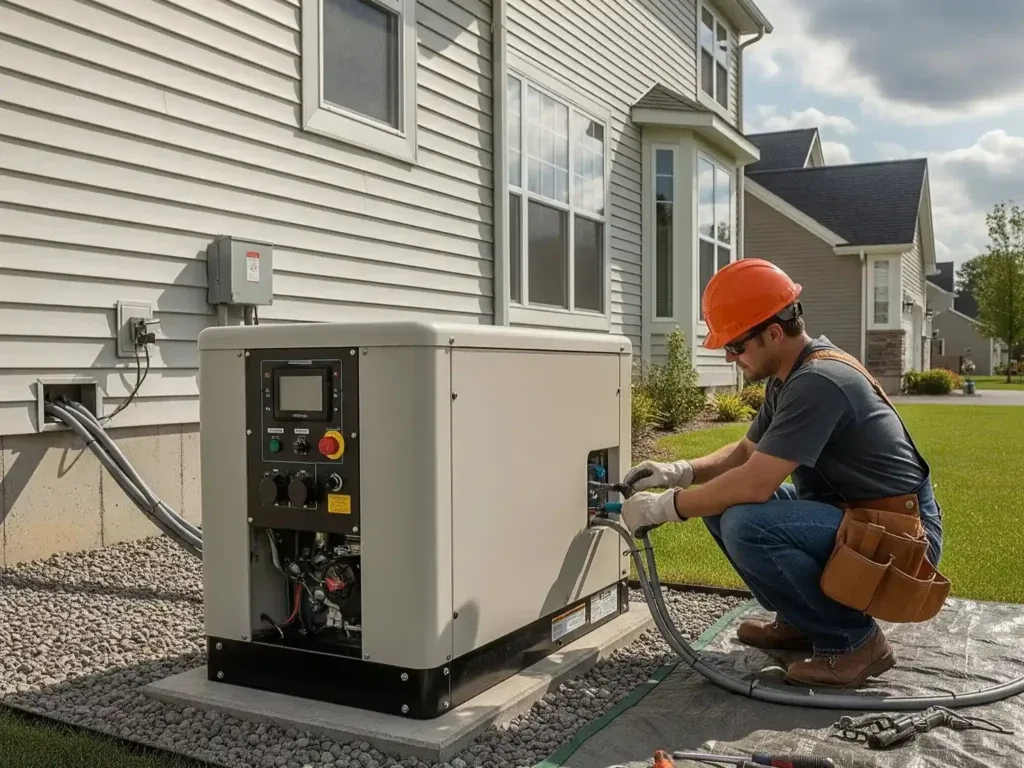
A whole house generator sits outside on a pad and runs on natural gas or propane. Gas lines and the generator unit itself are handled by the people who supply and set the equipment. We install the electrical side of Generac and other standby generators: the transfer switch, the wiring, the breaker and the grounding.
We coordinate with whoever is setting the unit so the final connection is clean, permitted and inspected. Sizing starts with a load calculation, so the generator you buy matches the circuits you actually want to run.
Portable Generators and Carbon Monoxide
If you own a portable generator, the most important rule is where it runs. Portable generators must run outdoors, well away from windows, doors and vents, because their exhaust contains carbon monoxide. You cannot see or smell it, and it can build up indoors quickly. A garage is not outdoors.
An inlet box solves the problem. The generator sits safely away from the house and a single cord brings power to the inlet. Working carbon monoxide alarms add a second layer, and our smoke and CO detector installation covers that.
What We Do on Installation Day
We protect your floors, mount the interlock or transfer switch, install the inlet or wire the standby unit and label every circuit you can power. The breaker we use for the generator is sized for your generator and your panel, so nothing runs hot when the furnace and fridge start together.
We then test the system with your generator so the first outage is not the first test. You get a written start-up procedure you can tape near the panel, photos of the finished work and a labeled panel directory.
Permits, Inspection and Panel Readiness
Every generator connection gets a permit. We pull it with Denver or whichever city or county covers your address and attend the inspection. If your panel is full, damaged or of a type that has no interlock kit, we will say so plainly. Sometimes the right first step is an electrical panel upgrade, and we can do both in one project.
What Affects the Price of Generator Installation
You get a written flat-rate price before we begin. The main things that shape it are:
- Interlock kit, transfer switch or full standby connection
- Your panel model and how many circuits you want backed up
- The distance from the inlet or generator pad to the panel
- Whether the existing wiring needs correcting
- Whether a panel upgrade is needed first
Generator Installation Across the Denver Metro
We serve Denver, Parker, Castle Rock, Highlands Ranch, Littleton and the rest of the surrounding areas. If you already have a generator and an unsafe hookup, or no plan at all, contact us for a free estimate.