
Start With the Cord That Looks Like a Shortcut
The power is out, the house is getting cold, and the generator in the garage cabinet suddenly feels like a good idea. Then you notice the dryer outlet, and a cord with a plug on each end. Someone online swears it works.
It does work, which is exactly the problem. That setup can send power backward through your house and out onto the lines, where a utility worker believes the wire is dead. A safe hookup takes a little planning. It is not hard once you see the pieces.
How to Connect a Generator to Your House: Four Parts
Every safe way to connect a generator to a house has the same four jobs covered. The pieces change a little from home to home, but the jobs do not.
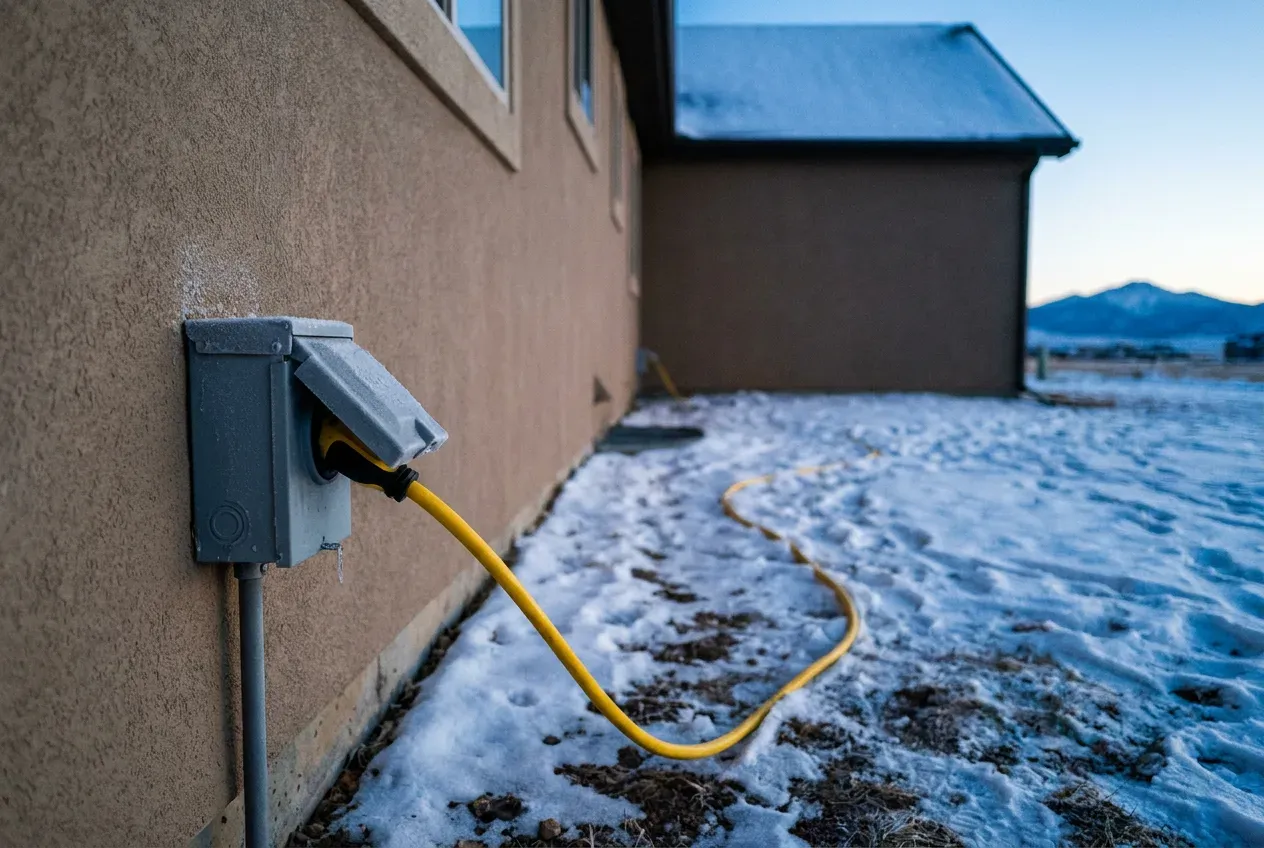
- A place to plug in. A power inlet box on the outside wall, wired to your panel, so the generator stays outdoors and the cord comes in through a weather-rated fitting.
- A matching cord. A heavy generator cord with the right connector on each end, one for the generator and one for the inlet.
- A way to keep the utility out. An interlock kit or a transfer switch, so the house is never fed by the generator and the grid at once.
- A safe place to run it. Outdoors, open to the air and away from the house.
To connect a generator to your house the right way, we take those four jobs in order.
What an Inlet Box and Cord Do
A generator inlet box is a small outdoor receptacle mounted on the wall near your panel. Behind it, a cable runs to a breaker in the panel. You plug the generator’s cord into the inlet, and the power reaches the house without anything running through a window or a door.
The inlet is more than tidy. It keeps the cord out of a cracked window and live prongs off the ground. It also gives the generator a connection point sized for the load.
We install inlet boxes and interlock kits together as part of our generator interlock and inlet installation, and the cable and breaker are matched to your generator before anything is wired.
The cord has to match two things: the outlet on your generator and the inlet on your wall. Generators put their larger outlets in different shapes, and a cord that is a little too light, or too long and thin, can heat up under a full load.
Buy the cord after you know your inlet and your generator, not before. Check it for cracks before each winter, and coil it somewhere dry. A bargain cord that runs hot is no bargain.
Interlock or Transfer Switch: What Keeps the Grid Safe
Both devices do one protective job. They just do it differently. An interlock is a mechanical plate on your main panel that lets the generator breaker turn on only when the main breaker is off. A transfer switch moves a chosen group of circuits between utility and generator power.
Which one fits depends on your panel, your generator and how many circuits you want. We cover that choice in interlock vs transfer switch, so this walkthrough stays on the hookup itself. Either way, hookups like this are permitted electrical work, and the inspection is a good thing to have on paper.
The Order of Operations When the Power Goes Out
With an interlock, the routine is short and worth writing on a card near the panel. Your electrician will label the pieces, and the steps run in this order:
- Turn off the main breaker and the large branch breakers, such as the range, dryer and water heater.
- Set the generator outdoors, then start it and let it settle.
- Plug the cord into the generator, then into the inlet box.
- Turn on the generator breaker, then turn on the branch breakers you need one at a time.
When the utility power comes back, reverse it. Branch breakers off, generator breaker off, generator stopped and cooled, cord unplugged, then the main breaker on. The order exists so the generator and the grid are never connected together.
A generator can only carry so much. Adding loads slowly lets you see when you are near its limit. If you are not sure which circuits to run first, the furnace fan, the refrigerator and a few lights are the usual start. When the panel is full or old, an electrical panel upgrade may come up before a hookup does.
Where to Put the Generator and What to Avoid
Carbon monoxide is the quiet danger. A gas generator gives off an invisible, odorless gas. It can reach the inside of a house through a window, a vent or an open garage door.
The Consumer Product Safety Commission says plainly to use portable generators outside, well away from windows, doors and vents, never in a garage, basement or shed, and to keep a working CO alarm in the house. Your generator manual lists its own clearance distance, so follow that number.
In winter, add two more habits. Keep the unit on level ground where drifting snow will not bury the exhaust, and give it a cover that lets air through, so rain and snow stay off the controls. A cord run to a good inlet makes that spot easy to use.
A few shortcuts show up every time the lights go out, and each one is dangerous.
- Plugging into the dryer outlet or any wall outlet. This is backfeeding, and it can kill a line worker.
- A double-male cord of any kind. It has live prongs on one end and nothing to keep the grid out.
- Running the generator in the garage, even with the door open. Carbon monoxide still builds up.
- Turning on the generator breaker while the main is on. This is the mistake an interlock exists to prevent.
If a previous owner left a homemade hookup, or you are not sure how your current one works, we can look at it and replace anything that does not belong.
What We Look At When You Call
A generator visit starts with your panel: its make, its age and how many open spaces it has. We look at where the inlet should go, how far the run is to the panel, and where the generator will sit outdoors, so the cord is not stretched across a walkway.
You get a written flat-rate price before work starts, and the hookup is labeled so anyone in the house can follow the steps. We serve Denver, Aurora and the surrounding service areas. Request a free estimate or call us at (720) 668-5051, and get the connection sorted before the next storm.