Two Good Ways to Feed a Level 2 Charger
The car is in the garage, the charging cord is in your hand, and there is a wall to mount something on. Do you want a plug-in outlet, or a charger wired straight into the circuit? It is the first real decision a new EV owner makes. Both give you Level 2 charging, which runs on 240 volts and refills a car overnight.
A NEMA 14-50 outlet is the common plug-in route. A hardwired charger skips the plug entirely. Neither one is wrong, and the right pick depends on your car, how you charge and who owns the garage.
What a NEMA 14-50 Outlet Is and What It Does Well
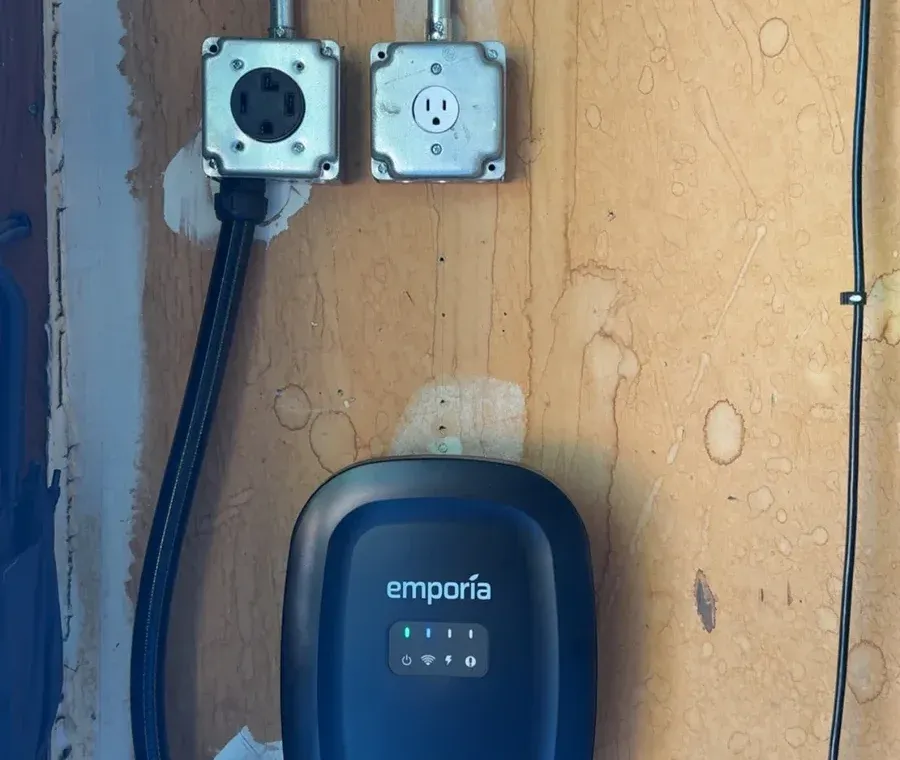
A NEMA 14-50 is a 240-volt, 50 amp receptacle with four slots. Electric ranges and RV pedestals use the same style. For EV charging, it feeds a portable charger or mobile connector that plugs into the wall, and we have wired plenty of them for Tesla, Rivian and Toyota owners and for Emporia chargers.
The outlet wins on flexibility. You can unplug the charger and take it to a new house, use the same outlet for a different brand later, or swap a failed unit in a minute.
Why a 50 Amp Circuit Charges at 40 Amps
Charging is a continuous load, which the code defines as anything expected to run three hours or more. Electrical Contractor magazine’s explanation of the EV charging rules says the breaker must be rated at no less than 125 percent of the charger’s maximum load, and the wire is sized the same way.
Work that backward and a 50 amp circuit supports 40 amps of charging. That is the usual ceiling for a plug-in charger on a 14-50. It still adds a lot of range overnight, and many daily commutes never need more.
How a Hardwired Charger Differs
A hardwired charger connects directly to the circuit inside the wall, with no plug and no receptacle in between. Because it skips the weak point, it can run on a 60 amp circuit and charge at up to 48 amps, as in a Tesla Wall Connector or similar unit. Our Tesla Wall Connector installation work is built around that setup.
Whether you gain anything depends on your car. Every EV accepts a maximum charging rate, and many cars charge no faster than a 40 amp circuit allows. We check your model before recommending the bigger circuit, because extra amps do nothing if the car cannot use them.
The Receptacle Is the Part That Wears
An EV charger can draw close to its full rating for six to ten hours at a stretch. A dryer receptacle, plugged in once and left alone, is not made for that. Emporia’s guide to 14-50 outlet safety explains that budget outlets use thin contacts that oxidize and wear down over thousands of charging cycles, and it suggests replacing an outlet after three to five years of heavy use.
Signs to watch for are a plug that feels loose, a discolored cover plate or a plug that is warm after charging. Any of those means stop. Unplug the charger and have the outlet looked at before you use it again.
If you go with an outlet, ask for one built for EV duty rather than a dryer-grade receptacle. Hardwiring removes the question altogether, which is why it is the better choice for a car you charge every night.
GFCI Protection and the Garage
Code now treats EV outlets as a shock risk. The 2020 National Electrical Code added section 625.54, which requires GFCI protection for all receptacles used for EV charging equipment. Local code adoption varies, so the rules at your address depend on the edition Denver, Aurora or your county has adopted.
A GFCI breaker is the usual way to meet it. Some chargers get along fine with one. Others trip it more often than you would like, which is one reason owners with a nuisance-tripping outlet end up switching to a hardwired unit with its own built-in protection. We sort out which setup fits your charger before we quote.
Weather, Garages and Driveways
Inside an attached garage, either option works. Out on a driveway wall, a carport or a detached garage, a hardwired charger in a weather-rated enclosure usually holds up better in Colorado winters than an outlet with a cord hanging off it. Snow, ice and a cable dragged through slush are hard on a plug.
Renters and anyone who expects to move should lean toward the outlet. That is a fair call. Owners who plan to stay and charge daily should lean toward hardwired.
Does Your Panel Have Room for Either One?
Either way, the NEMA 14-50 outlet or the hardwired unit pulls a full dedicated 240-volt circuit from your panel, and the load calculation comes first either way. We cover that in detail in our guide on whether you need a panel upgrade for an EV charger. If the answer is no, an electrical panel upgrade can be handled in the same project.
A new 240-volt circuit also needs an electrical permit and an inspection, whether it ends in a plug or a charger. Rebates and incentives change, so ask us about the Xcel Energy paperwork when you book.
Choosing Between a 14-50 Outlet and a Hardwired Charger
Choose the outlet when you rent, when you may move soon, when you charge a few times a week, or when you already own a portable charger. Choose hardwired when you charge every night, want the full 48 amps for a car that can take them, park outdoors or want the fewest parts that can fail.
Not sure which fits? Our EV charger installation team in Denver and Aurora can look at your car, panel and parking spot together. Request a free estimate or call (720) 668-5051, and you will get a written flat-rate price before any work starts.