
Start With What Your Panel Can Actually Carry
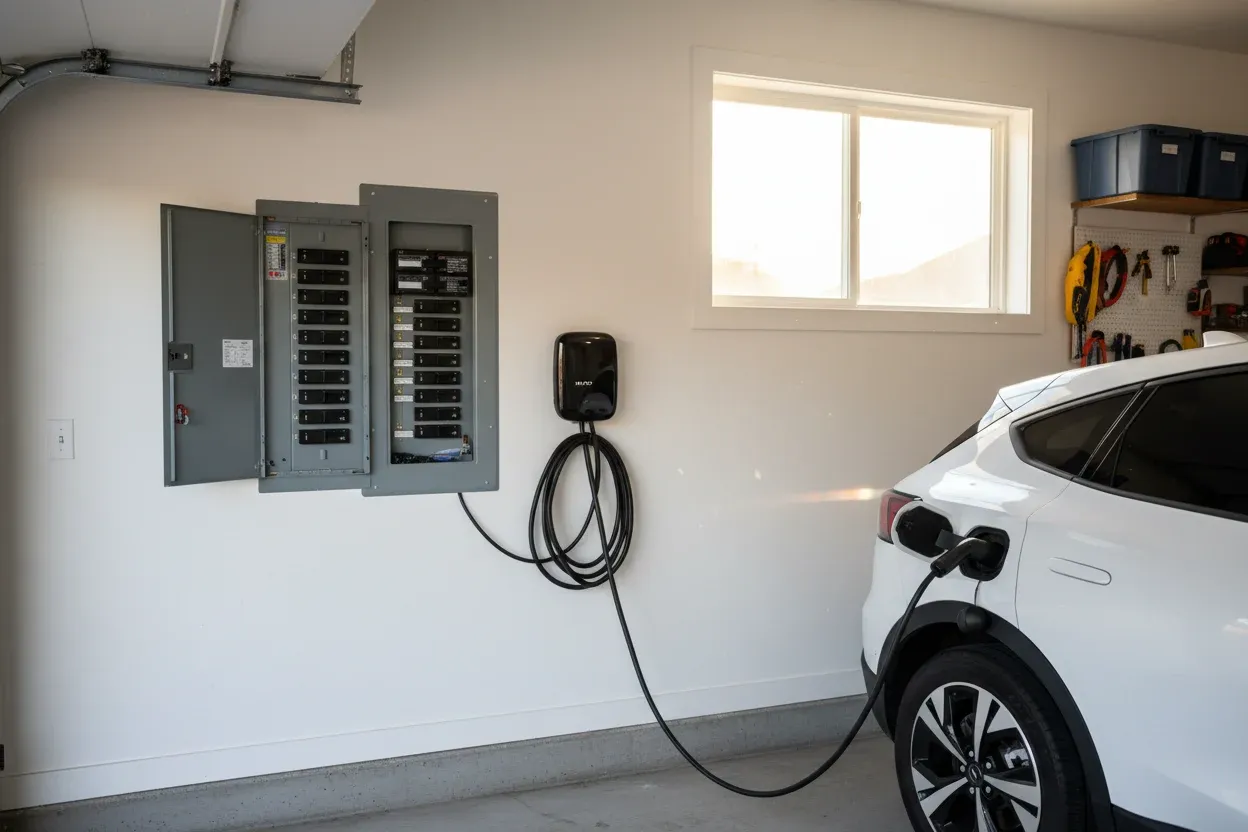
You ordered the charger, or you are about to, and then the question hits. Does the breaker box in the garage have enough in it to feed a car? It is a fair worry. A Level 2 charger is one of the biggest loads a home ever adds, and the answer depends on your house, not on the charger.
Plenty of Denver homes can take a charger with no upgrade at all. Others need a little help, and some really do need a bigger service. Here is how to tell which group you are in, and what to do about it.
Service Size: 100 Amp Versus 200 Amp
Your home’s service size is the total amount of power that can come in from the utility. Open the panel door and look at the big breaker at the top, usually labeled 100 or 200. That number is your service size.
A 200 amp service gives most homes comfortable room for a charger. A 100 amp service is tighter, especially if you also have an electric range, electric dryer, central air conditioning or electric heat. Many 100 amp homes still work, with the right charger settings. The main breaker tells you where you start, not where you end up.
Open Breaker Spaces Do Not Equal Open Capacity
The most common mistake is counting empty slots. A panel can have four open spaces and still be out of power, because spaces are physical slots and capacity is how much electricity the service can deliver at once.
The reverse happens too. A panel with no open spaces can often be fixed without a full replacement, by rearranging circuits or adding a subpanel. So empty slots are useful information, but they do not answer the question. Only a calculation does.
What a Load Calculation Tells You
A load calculation is the method electricians use, following the National Electrical Code, to estimate the most power your home can demand at one time. It adds up your lighting, appliances, heating, cooling and the new charger, and compares the total to your service size.
We run that calculation before we quote, so you know the answer before you buy anything. For some homes, we can also work from the actual measured demand of the house. You get a clear yes, a yes with conditions, or a recommendation to upgrade.
Why a 48 Amp Charger Needs a 60 Amp Circuit
An EV charger is a continuous load, which means it can draw full power for hours. The electrical code treats anything running three hours or more as continuous, and requires the circuit to be sized with extra room. That is why a 48 amp charger needs a 60 amp circuit.
This matters for your panel because the breaker reserves that full amount of capacity on paper. A big charger on a busy panel can tip a calculation from fine to overloaded, even if the car never draws that much in practice.
Older Homes and Extra Big Loads
Denver has plenty of homes from every era, and the age of your panel matters as much as its size. Older panels may have fewer spaces, worn breakers or brands with a poor safety record. A charger is a good reason to have someone look inside and check the condition, not just the rating.
Other big appliances count too. An electric range, electric dryer, central air conditioner, heat pump, hot tub or a second EV all draw from the same service. We include them in the calculation, along with anything you plan to add in the next few years.
Ways to Avoid an Upgrade
If your calculation comes up short, an upgrade is not the only path. These options often solve the problem for less work:
- A smaller charger or lower setting. Many chargers can be set to 32 or 40 amps. Overnight, that still refills most daily commutes.
- Load management. An EV energy management device watches your home’s total demand and slows the charger when the house needs power, then speeds it back up.
- Circuit sharing. Two chargers, or a charger and another big appliance, can share one circuit and balance the load automatically.
- Panel rearranging. Swapping in tandem breakers where allowed, or adding a subpanel, can free spaces without replacing the service.
The right choice depends on how you drive and what your house runs on. A car that sits for ten hours every night does not need the fastest charger available.
When a Panel Upgrade Really Is the Right Call
Sometimes the honest answer is that the panel should be replaced. Signs include a service that is already near its limit, an older panel with known problems such as Federal Pacific or Zinsco equipment, scorched or rusted components, or plans for more big loads like a heat pump, hot tub or second EV.
In those cases, putting a charger on an aging panel is the wrong way to spend money. Our electrical panel upgrade work moves homes up to 200 amp service, so the charger and the next few additions all have room.
What a Panel Upgrade Involves
An upgrade is a real project, but it is a predictable one. Here is the usual sequence:
- We review your load calculation and confirm the new service size.
- We pull the electrical permit with the jurisdiction that covers your address.
- We coordinate with your utility, Xcel Energy or CORE Electric Cooperative depending on your address, for the power disconnect and reconnect.
- We install the new panel, label every circuit and restore power.
- The inspector signs off, and we schedule and attend that inspection.
You lose power for part of a day, and we tell you the plan ahead of time. You also get a labeled panel directory and photos of the finished work.
Put a Number on It Before You Buy
The smartest time to ask this question is before you buy the charger. The same load calculation that answers it also tells us which charger settings make sense and where the circuit should run. Our EV charger installation in Denver starts exactly there, and Tesla owners can see how we handle a Tesla Wall Connector install with power sharing.
Rebates and incentives for chargers and panel work change, so we do not quote them here. When a program applies, we help with the Xcel Energy paperwork.
Ready for a Clear Answer About Your Panel?
If you are not sure what your panel can take, we are glad to look. Request a free estimate or call us at (720) 668-5051. You get a written flat-rate price before any work starts, and a clear answer on whether an upgrade is needed at all.