
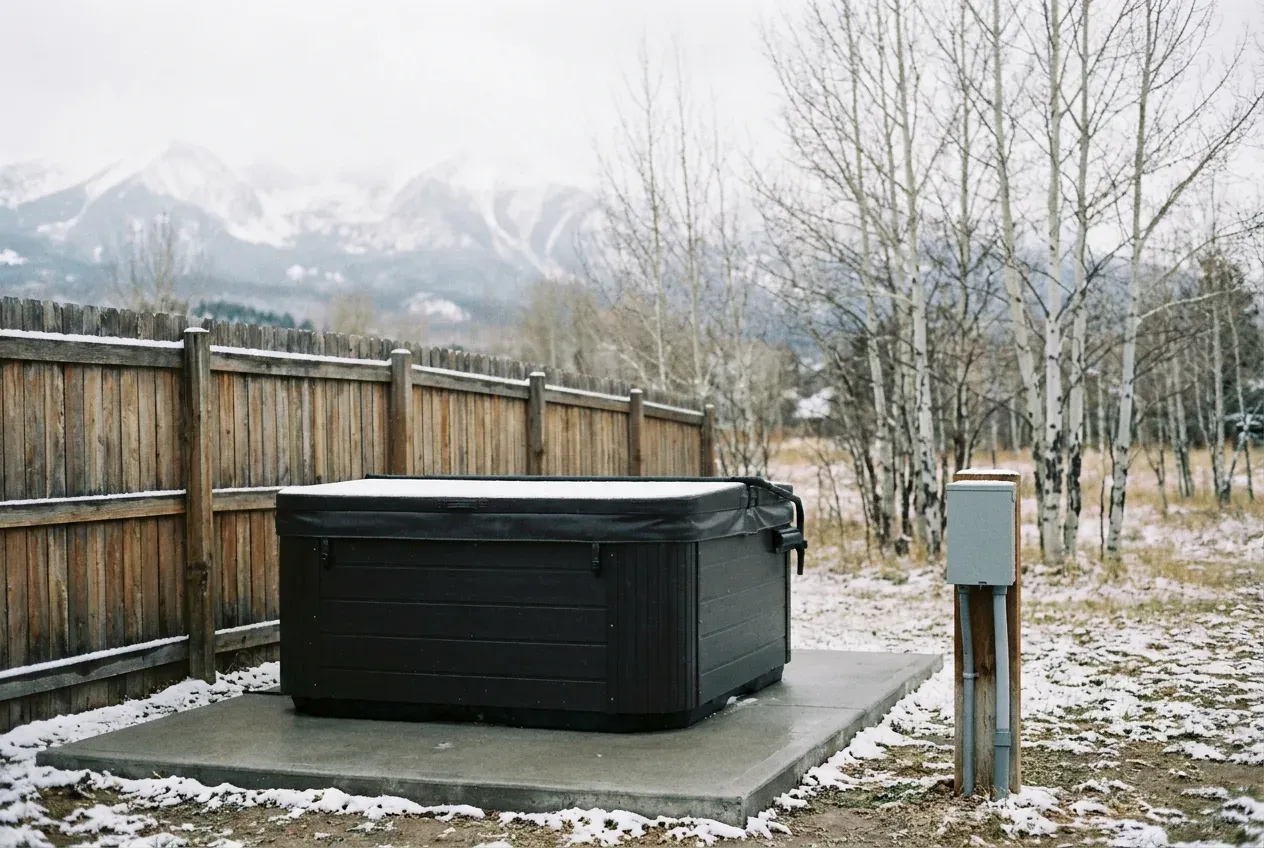
The Truck Comes Saturday and the Power Is Not Ready
A lot of hot tub buyers reach this point with a pad in the backyard and no plan for where the power comes from. It is a common spot to be in, and it is fixable. The trick is knowing which questions to settle first.
Hot tub electrical requirements are not complicated, but they are strict. Water, metal and 240 volts share a small space, so the code treats spas more carefully than almost anything else at your house. Settle these before delivery day.
Hot Tub Electrical Requirements Start With the Manual
Every tub arrives with an installation manual, and its electrical page is the first thing your electrician needs. It lists the voltage, the amperage, how many wires, and whether the tub is meant to be hardwired or plugged in. Those numbers differ from model to model.
Manufacturers like Artesian Spas publish this plainly. Their 120-volt models call for a dedicated 15 to 20 amp circuit and their 240-volt models a dedicated 40 to 60 amp circuit, and they say a qualified electrician must do the work. Your model may differ, so the manual for your tub governs.
Dedicated Circuit and GFCI Protection
A hot tub gets a circuit of its own. Nothing else shares it, which means no lights, no outlets and no other appliances. The tub’s heater and pumps can pull a lot of power at once, and a shared line is how breakers start tripping on a cold night.
Ground-fault protection is part of the package too. A GFCI watches for current leaking where it should not, and it cuts power almost instantly. Depending on the tub, that protection is a GFCI breaker in the panel or a GFCI spa disconnect outside. If your breaker keeps tripping later, our electrical repair service can trace it.
The Disconnect and Where It Goes
A hardwired tub needs a switch that shuts off power to the whole tub. The building division in Broomfield, Colorado, summarizes the 2023 National Electrical Code this way: the disconnect must be readily accessible, within sight of the tub, and at least 5 feet from the inside walls of the tub.
That is a location puzzle as much as an electrical one. You want the switch where you can reach it without stepping toward the water, and where the tub cover, steps and gate do not block it. We pick the spot with you before the trench is dug. Local rules can add details, so we confirm on the permit.
Plug-and-Play Versus Hardwired
Hot tubs come in two electrical flavors. Plug-and-play tubs run on 120 volts, plug into a GFCI-protected outlet and are usually smaller. Hardwired tubs run on 240 volts, connect straight to a circuit and are usually larger, with more powerful heaters and jets.
Plug-and-play sounds easier, and sometimes it is. But it still needs its own dedicated GFCI-protected circuit, and a small tub can struggle to keep up in a Colorado January. Hardwired tubs recover faster and handle cold better. Ask your dealer which kind you are buying, then have the wiring match the model. Our hot tub wiring in Denver page covers both.
What Hot Tub Electrical Requirements Mean for Your Panel
A 240-volt hot tub is a big new load. If your panel is already carrying an electric dryer, an oven, air conditioning or an EV charger, the tub may not fit without help. Open breaker slots do not settle that. A load calculation does, and we run one before quoting.
If the numbers come up short, an electrical panel upgrade can be done in the same project. Our post on whether you need a panel upgrade for an EV charger explains the same capacity math, which works for tubs too.
Distance, Trenching and the Permit
The farther the tub sits from the panel, the more wire, conduit and digging the job takes. Underground runs have their own burial rules, and the utility locate comes first, so we map the route with you before anyone picks up a shovel. A run along a deck or a house wall is often shorter.
Permits are the other piece. Denver, Aurora and the surrounding cities and counties each handle them their own way, and some building departments want a permit for the tub placement as well. Ask early, because an inspection has to happen before most dealers will connect the tub.
Winter in Colorado Changes the Plan
Colorado is a great place to sit in hot water while it snows, and that is exactly when a tub works hardest. The heater runs more often, so the circuit sees steady use through the cold months. A circuit that is sized to the manual handles that without drama.
Cold also affects the work itself. Frozen ground slows a trench, and a snowstorm can move an inspection. If delivery is set for November or December, book the electrician first and the delivery crew second, so the power is not what holds up your first soak.
What Your Dealer Will and Will Not Do
Dealers set the tub and, in many cases, fill it and run the first checks. What they generally will not do is wire it, and many will not connect a tub to a circuit that has not passed inspection. Ask your dealer what they expect to see on delivery day, and get it in writing if you can.
It also helps to ask what the installation manual says about the pad, the clearance around the tub and access for service. The electrical side has to work with those, because a disconnect that blocks the tub’s service panel is a headache later.
A Short List Before Delivery Day
Walk through these with your dealer and your electrician:
- The installation manual for your exact model
- Plug-in or hardwired, and the voltage
- The route from the panel to the pad
- Room in the panel, confirmed by a load calculation
- The disconnect location, set before the pad is final
- The permit and inspection date, set ahead of delivery
If you want a second set of eyes, send us the model and the delivery date through the contact page. We wire tubs across Aurora and the rest of the Denver area.