What a Home Inspection Report Just Told You
The inspection came back, and there it is on page six: “Federal Pacific panel, recommend evaluation by a qualified electrician.” Maybe you are buying the house, maybe you are insuring it, or maybe you have simply lived with a gray metal box in the basement for twenty years and never read the label.
A Federal Pacific panel is not an emergency by itself, and it is not something to ignore either. The label tells you what you have. The documented concerns and your plans tell you whether to replace it or keep it.
How to Tell If You Have a Federal Pacific Panel
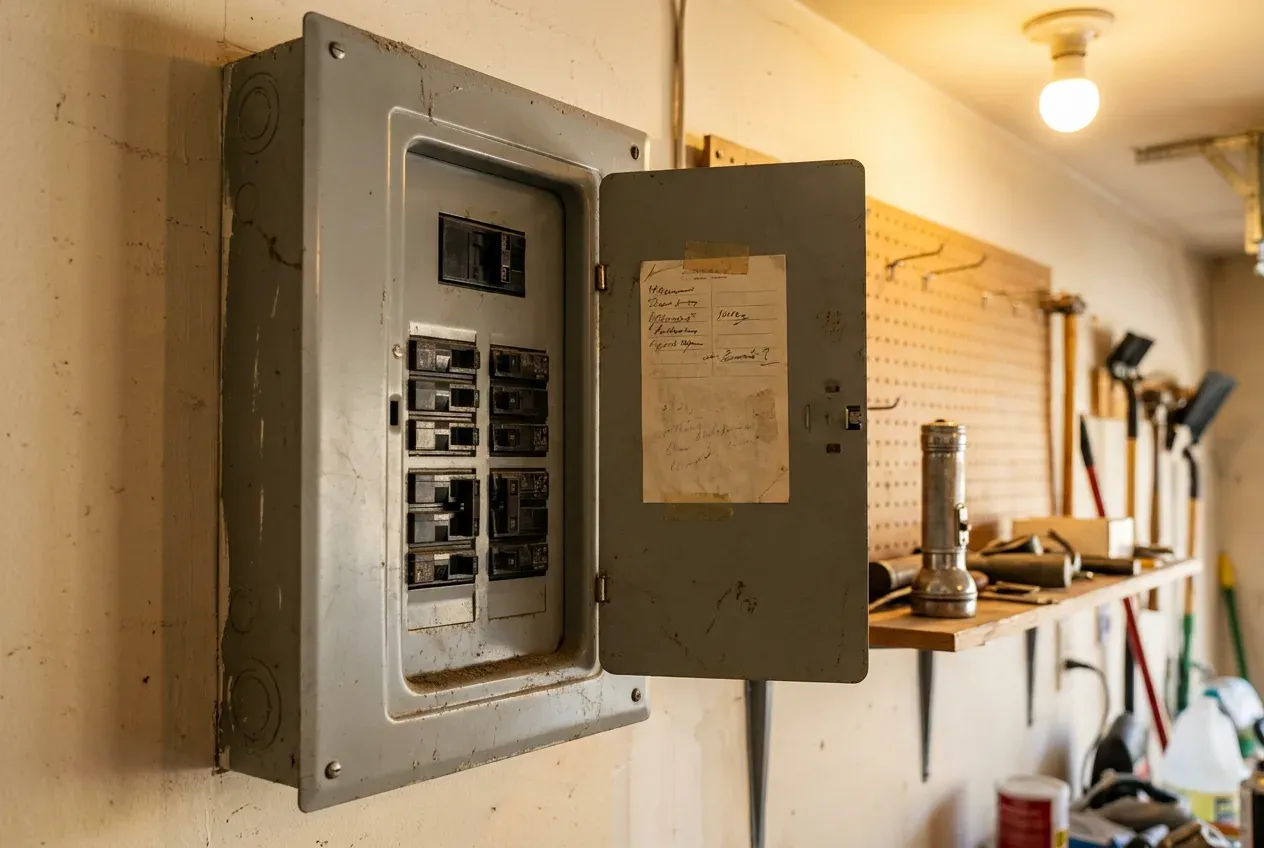
Start with the label. Open the panel door and read what is printed inside or on the cover. Federal Pacific Electric, FPE and Stab-Lok are the names to look for. The breakers themselves often carry the same branding, and many have a color-coded or striped handle.
Leave the metal cover on. The wires behind it are live, and the label tells you most of what you need. Take a clear photo of the door and any stickers, and send it to us. We can usually tell from the photo whether a visit is worth your time.
What Makes These Panels a Concern
A breaker has one job. When a circuit draws too much current, it trips and shuts the circuit off. The documented concern with Stab-Lok breakers is that some of them do not do that reliably. The Hanover Insurance Group notes that testing found certain Stab-Lok breakers do not trip according to UL requirements and, in some cases, can jam in the “on” position.
Inspectapedia, a long-running reference for inspectors, adds an honest caveat. Failures do not happen in every breaker, and some may perform adequately. You cannot know which ones. A breaker that fails quietly is one you never hear about. The U.S. Consumer Product Safety Commission looked into these panels in the early 1980s, said it lacked the funds to pursue testing, and no recall followed.
Where Zinsco and Challenger Panels Fit
Zinsco is a different brand with a different concern. Zinsco equipment is considered obsolete because of a design flaw in which the breaker’s connection to the bus bar can loosen. That can cause arcing and heat, and in some cases the breaker fuses to the bus and may not trip.
Zinsco panels were widely installed through the 1960s and 1970s. Later versions carry the Sylvania, GTE-Sylvania or Challenger name, so a panel with one of those labels deserves the same look. Breakers can appear normal from the outside, which is why we check the bus and connections once the cover is off.
Replace or Keep: A Fair Way to Decide
We sort it into three groups.
- Replace it if a home inspector or insurer has flagged it, if you are buying or selling, or if any breaker looks scorched, feels hot, buzzes or has been stuck.
- Replace it if you are adding an EV charger, heat pump, hot tub or other big load. The panel upgrade question for an EV charger is a good example of when the old box runs out of road.
- Keep it for now only after an electrician has looked at it and you have a plan with a date.
Most references, including the insurer and inspection sources above, lean toward replacement, and so do we. Swapping in a few new breakers does not address a panel whose design is the question.
What Replacing a Federal Pacific Panel Involves
A replacement is a planned job. We look at the existing panel, run a load calculation to confirm the size of the service, and put a written flat-rate price in front of you before work starts. A new panel needs an electrical permit and an inspection, and when the meter has to come out we coordinate the Xcel Energy disconnect and reconnect.
On the day, we lay down floor protection, move each circuit to a new breaker, label everything and correct grounding problems we find along the way. You get photos and a labeled directory when we leave. Our electrical panel upgrade page walks through the full sequence.
What Inspectors and Insurers Do With the Finding
A home inspector is not saying your house is on fire. The report flags the brand because the documented history gives them a reason to recommend a closer look by an electrician. In a sale, that recommendation often lands in the repair request or the negotiation, so it helps to have a written answer ready.
Insurers handle it in different ways. Some ask for an electrician’s report, some adjust terms, and some want the panel replaced before they write or renew a policy. Call your own company and ask. A permitted replacement with a passed inspection gives you something concrete to hand them.
The 80% Rule, in Plain Terms
This question comes up next to panel brands, so here is the short answer. The 80% rule is a sizing rule for circuits that run for three hours or more, such as an EV charger or a space heater. The breaker should be rated at least 125% of that steady load, which means the load stays at or under 80% of the breaker.
A 20 amp breaker is planned for 16 amps of continuous draw. The rule has nothing to do with Federal Pacific or Zinsco on its own, but it is the same logic we use when we size a new panel and its circuits.
What to Do This Week
Do not panic. Do not sit on it either. Take a photo of the panel label and the breaker handles, note any breaker that trips often or feels warm, and make sure the smoke detectors in the house work. If a breaker ever buzzes, smells hot or looks scorched, stop using that circuit and call an electrician.
Denver, Aurora, Littleton and Columbine Homes
Plenty of homes in the metro were built in the decades when these panels were common. We see that story in Aurora, Littleton and Columbine, and you can find the other places we work on our service areas page.
The price depends on the same things as any panel job, such as the distance from meter to panel, whether the service is also being upgraded and what the inspector expects. Jordan, a Colorado master electrician, can look at yours and explain what he finds in plain language.
Ready to Find Out What You Have?
If your inspection report, your insurer or your own curiosity brought you here, we are glad to look. Request a free estimate or call us at (720) 668-5051. Send a photo of the panel label if you have one, and we will tell you what we see.